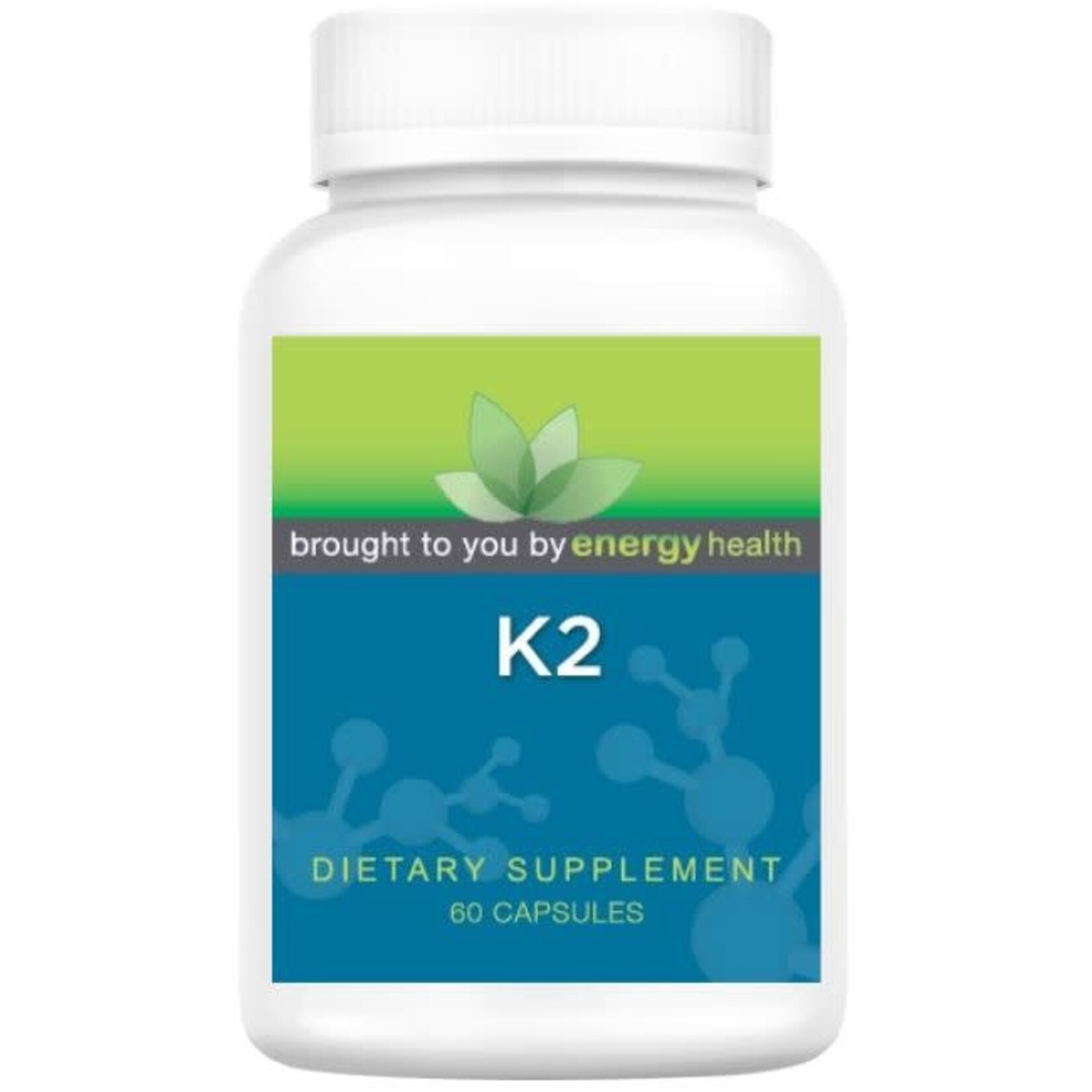
Emerging research highlights the importance of optimal intake of vitamin K and its critical role in maintaining bone and cardiovascular health. Composed of a group of naturally occurring and structurally similar, fat-soluble vitamins, vitamin K is required for the proper utilization of calcium and helps to bind newly absorbed calcium to the bone matrix. Vitamin K helps maintain bone mineral density by decreasing the activity of osteoclasts, cells which break down bone.1 It also provides critical cardiovascular protection by activating matrix Gla protein (MGP), a potent inhibitor of circulatory calcification. Current research has found high concentration supplementation, at 180 μg/day, results in improved clinical results compared to lower-dose supplementation. K2 provides an optimal dose of soy-free vitamin K2 delivered in the MK-7 form for optimal support of bone, cardiovascular and immune health.
Calcium and vitamin D are important mediators in bone growth, but vitamin K plays an equally important role. The synthesis of bone growth is dependent on vitamin K, through its carboxylation of osteocalcin, a protein secreted by osteoblasts. Osteocalcin guides calcium into bones and prevents its absorption into organs, joint spaces and arteries. Vitamin K occurs in two forms: K1 (phylloquinone), found primarily in the liver, naturally occurs in green leafy vegetables and is considered to be the main dietary source and K2 (menaquinone), which is a group name for a family of related compounds differentiated by their side chains. MK-4 and MK-7 are the two subclasses of K2 most widely studied for their role in bone and cardiovascular health. The MK-7 form is substantially more active, has a longer half-life and accumulates to higher concentrations in serum than vitamin K1 and MK-4. The different degrees of bioavailability between MK-4 and MK-7 are due to differences in structure. The long side-chain of MK-7 allows it to bind with fat particles in circulation. This process then allows easier facilitation to soft tissue, bones and arteries. More recently, research has shown that doses of 180 mcg of MK-7 provide greater results when supporting both bone and cardiovascular health. The addition of MenaQ7® PRO to this formula is backed by extensive research. Dr. Leon Schurgers, world-renowned expert in vitamin K2 as MK-7 research for cardiovascular and bone health, and his team of research scientists have conducted over 15 clinical trials on MenaQ7® PRO through the University of Maastricht.